Can an AI running inside the hospital spot a stroke in a triage note?
Preprint posted to medRxiv, 5 August 2026 · Summary posted 9 August 2026
In plain language
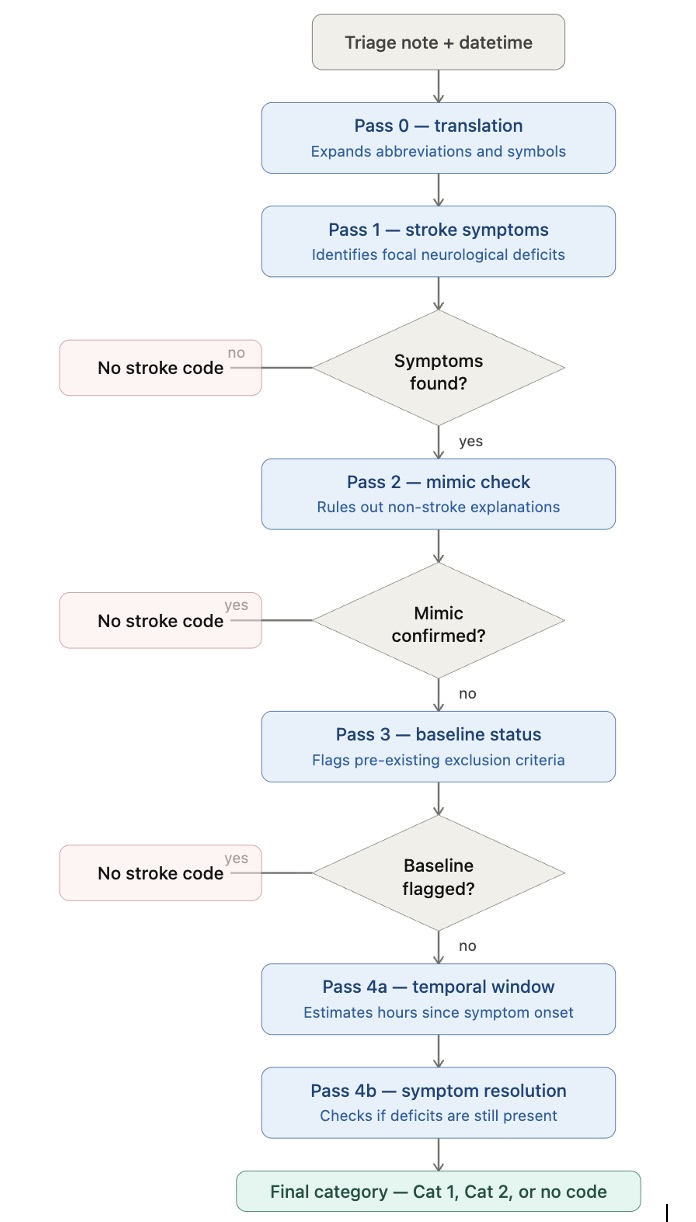
When someone arrives at an emergency department with a possible stroke, the first record of their visit is usually a short note typed by a triage nurse. That note is where the hospital's Code Stroke pathway is meant to be triggered. It is also where strokes get missed: published estimates put the figure at roughly 10–20%, and the people most often missed are those with language difficulty, with symptoms coming from the back of the brain, or who do not speak English as a first language. Because every hour of delay to reopening a blocked vessel lowers the chance of returning to independent living, a missed note at triage carries real cost.
This study asked whether an artificial intelligence language model could read those notes and flag the patients who met Code Stroke criteria. Two design choices mattered as much as the result. The first was that the models ran entirely on a single computer inside the hospital, with no internet connection and no patient information ever leaving the building. The second was that instead of asking the model one large question, the pipeline broke the decision into a chain of small ones: are there focal neurological symptoms, is this better explained by something that mimics a stroke, what was the person's baseline, when did symptoms start, have they already resolved.
We ran the pipeline over 3,023 consecutive emergency presentations at Monash Medical Centre and compared its answers against a neurologist who reviewed every note blinded to what actually happened. The best-performing model correctly flagged 89% of the presentations the neurologist judged Code Stroke–eligible, while correctly leaving alone 99.3% of everyone else. A second neurologist, independently re-reviewing a sample of notes, agreed with the first almost perfectly.
The most useful finding may be about how the question is asked rather than which model answers it. When the same clinical criteria were collapsed into a single large prompt, one model's flagging rate went up but its judgement collapsed — it raised more than 1,200 false alarms where the step-by-step version raised 140. In an emergency department, that difference is the difference between a useful safety net and an alarm everyone learns to ignore.
Why it matters
Most clinical AI tools require sending patient data to an external provider, or training a model on patient records. This pipeline does neither, which removes two of the larger obstacles to getting such a tool approved and running in a public hospital. It also needs only a single consumer graphics card, so it is within reach of an individual department rather than requiring enterprise infrastructure.
Some caution is warranted. This was a retrospective study at one hospital over one month, and the notes were written in English with Australian clinical shorthand. Testing it live in a working triage department, and then across several hospitals, is the necessary next step before anything like this should influence care. The intent is a safety net that sits behind clinical judgement, not a replacement for it.
Try the pipeline
A working demonstration of the classifier is available online. You can type a free-text triage note, set a note time, choose between a lightweight and a larger model, and watch the chain work through each reasoning step to a final category.
Please read first. This is a research prototype, not a medical device, and it has not been evaluated or approved for clinical use. Its output is not clinical advice and must not be used to make decisions about anyone's care, including your own. Unlike the on-device configuration described in the paper, the demonstration site is cloud-hosted — so please enter only invented or fully de-identified text, never a real patient's note or any information that could identify a person.
The paper
This is a summary of a research preprint written for general readers, not medical advice. The underlying manuscript has not been certified by peer review and should not be used to guide clinical practice. If you or someone you care for has symptoms of stroke, call 000 (in Australia) immediately. For questions about your own health, please speak with your doctor.
← Back to all research summaries